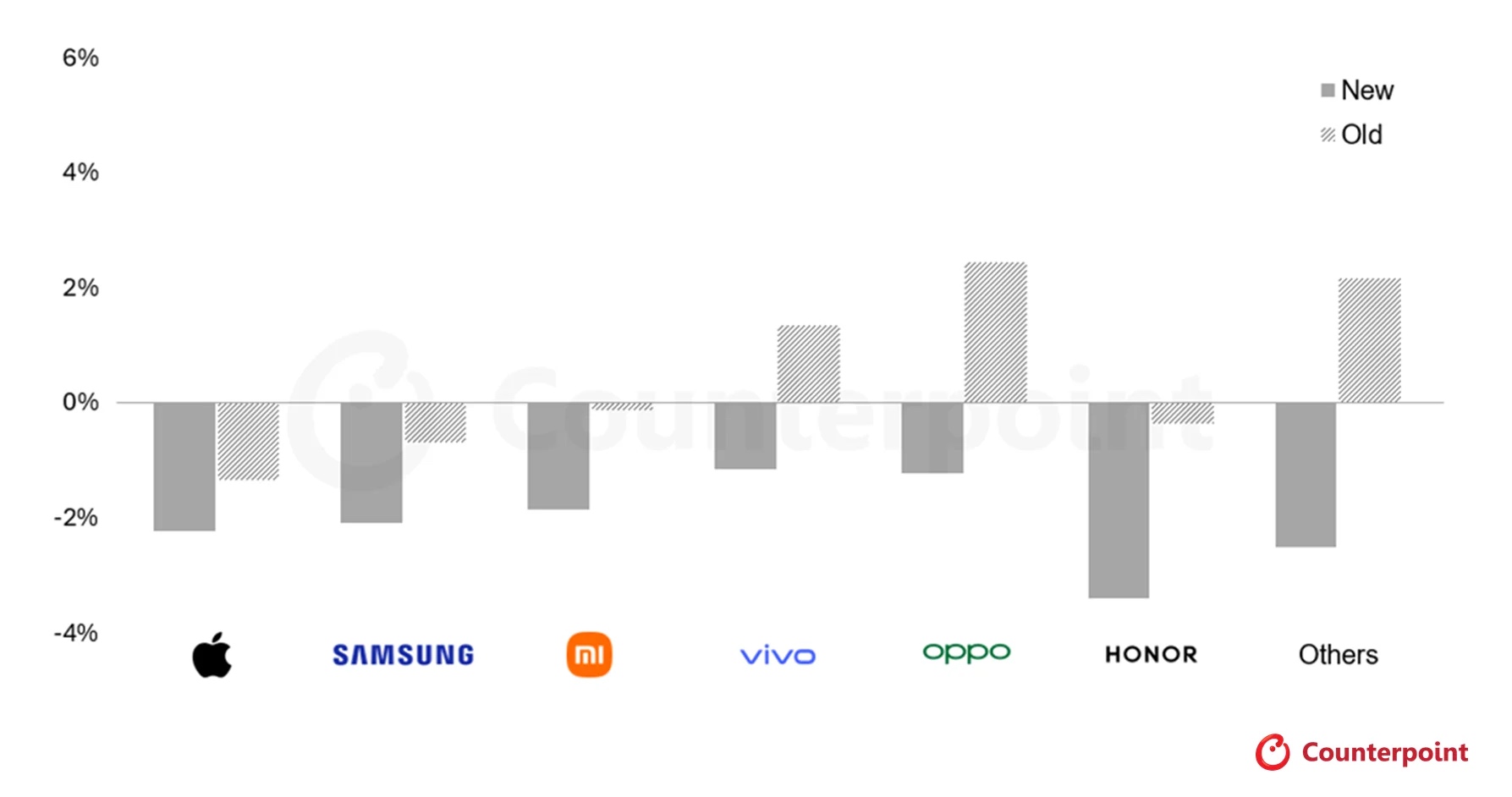
Market intelligence company Counterpoint Research predicts that Apple will see iPhone sales numbers fall next year, experiencing a 2.2% year-on-year slip. In addition, smartphone companies will also be hit with steeply increased manufacturing costs, although Apple and Samsung are better positioned to handle such increases.
Counterpoint expects global smartphone shipments to slide 2.1% overall in 2026. Apple is expected to be among the hardest hit, likely see a 2.2% year-on-year fall in iPhone sales. The Cupertino company is expected to take a harder hit than many other smartphone makers, Such as Mi, Oppo, and Samsung.
The companies are also expected to face significantly steeper manufacturing costs in 2026, thanks to rapidly rising component costs, especially for memory.
“What we are seeing now is the low end of the market (below $200) being impacted most severely, with BoM (bill of materials) costs increasing by 20%-30% since the beginning of the year,” said Research Director MS Hwang. “The market’s mid- and high-end segments have seen 10%-15% price increases.”
While Apple and Samsung are said to be better equipped to handle rising component costs, companies that sell lower-end smartphones will be hit particularly hard. Counterpoint Research says memory prices could rise another 40% through Q2 2026, resulting in BoM costs anywhere between 8% and over 15% higher than current levels.
This may result in low-end vendors using cheaper components, reusing older components, and cutting back on features, and eliminating some model lineups. Lower-end Android handsets make up a large part of global smartphone sales.
Apple and Samsung are in a better place than most smartphone companies, thanks to their long-term supply deals, limiting their exposure to rapid price increases.
“Apple and Samsung are best positioned to weather the next few quarters,” said Senior Analyst Yang Wang. “But it will be tough for others that don’t have as much wiggle room to manage market share versus profit margins. We will see this play out especially with the Chinese OEMs as the year progresses.”
Counterpoint expects to see average selling prices increase next year by 6.9%, revised up from 3.9% its September 2025 forecast.