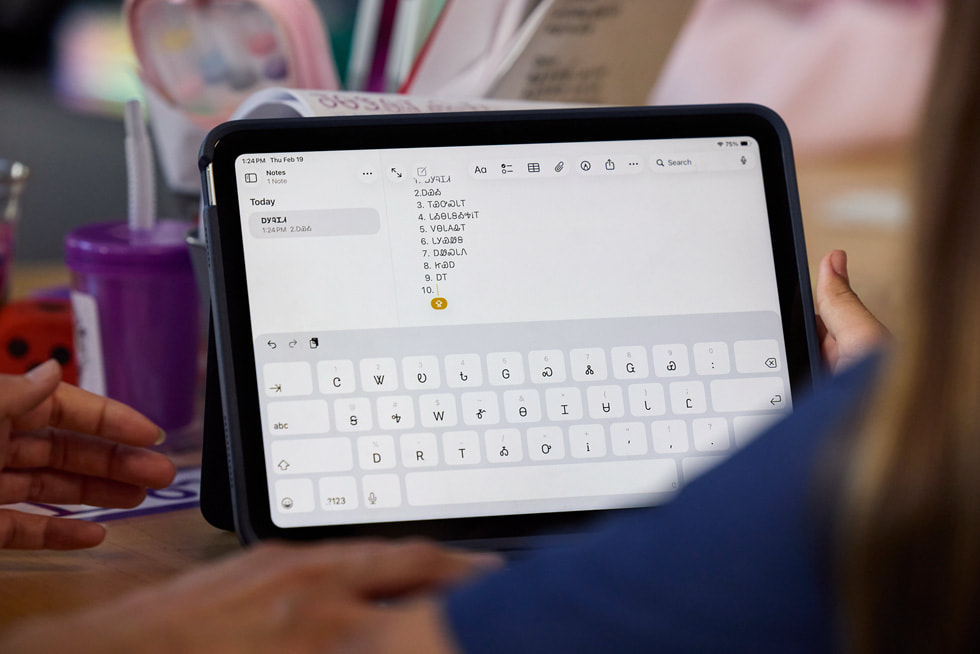
Today, there are nearly half a million Cherokee people around the globe, yet on fewer than 1,500 are fluent speakers of the tribe’s language. Now, student and teachers are using iPads and Macs to save the endangered language.
At the Cherokee Immersion School in Tahlequah, Oklahoma, the hallways are buzzing with young learners traveling from one classroom to the next. Serving students from pre-kindergarten through eighth grade, the immersion school — a branch of the Durbin Feeling Language Center — is tasked with creating the next generation of Cherokee language speakers.
Apple is helping the Cherokee Nation, and their partners at Oklahoma City University (OCU), revitalize the Cherokee language and culture. Through its Community Education Initiative, Apple is helping to equip teachers and young learners with iPad and Mac at the Cherokee Immersion School and nearby Sequoyah High School.
Students are able to record themselves reciting vocabulary on iPad, allowing them to practice their pronunciation at home. It’s a powerful tool that fifth grade teacher Erlinda “Daksi” Soap is using to help her students prepare for the upcoming Cherokee Language Challenge Bowl.
“They’re really language warriors,” says Soap. “Our mission here at Cherokee Nation and the Durbin Feeling Language Center is to find our future Cherokee leaders, those who are willing to share the language and continue growing the language.”
“At first they would write words on their own on paper in pencil, but now they’re able to record themselves and study those words at school and at home,” says Soap.
“In Cherokee language, every sound is so important,” says Soap. “One sound off, and you’re saying a completely different word.”
Meanwhile, students in teacher Tyler Teague’s class use Apple’s Keynote to create animated stories on the iPad. This gives students a chance to record themselves narrating a story, encouraging storytelling, which has long been a key component of how both the Cherokee language and culture get shared from one generation to the next.
Teague has hopes that eventually he and his students can create a custom machine learning model, even creating an app using Apple’s Swift Playground.
In the STREAM (science, technology, research, engineering, art, and math) Lab, ribbon skirts hang from clothing racks alongside Mac computers, large-format printers, and sewing machines. The students are using iPad and Apple Pencil to design their own skirts before hand sewing them. The lab also serves as a studio for the student-run podcast, Stories of Sequoyah. Teacher Melissa Fourkiller is assisting a group of students who are conducting an interview with Sam Horsechief, an elder in the community who’s been coaching at the school since 1987. They’re recording and editing the audio for an upcoming episode.
“In the STREAM classroom, sewing, storytelling, and digital media come together,” Fourkiller says. “Students create traditional items while learning the cultural meaning behind them, and they use Apple tools like GarageBand on Mac computers to produce podcasts that respectfully preserve and share Cherokee stories. Through these projects, they develop creativity, collaboration, and problem-solving skills while learning to use technology with purpose.”
“The technology that we utilize with Apple has allowed us to take everything that we really are trying to achieve here, which is the perpetuation and the revitalization of Cherokee language and culture, and use that same technology to make it relevant to the young people that are learning here,” says Chuck Hoskin Jr., the Cherokee Nation’s principal chief.