As first noticed by MacRumors, 12 years ago today, Apple bowed to pressure from iTunes customers and provided a web page designed to perform one task: delete the free U2 album the Cupertino firm had “forced” upon them.
Five days earlier, at Apple’s September 9, 2014, iPhone 6 event, Apple CEO at the time, Tim Cook, announced that every iTunes customer would receive U2’s new album “Songs of Innocence” for free. Why, not only was the album free, customers wouldn’t need to do anything to receive it. The album would be automatically linked to the customers’ accounts and the album would also download automatically to their devices without their explicit permission.
The Internet promptly freaked out, prompting Apple to create a special tool to remove the free album from devices. To remove the offending U2 album, users were instructed to visit a provided link and use Apple’s removal tool that automatically removed the U2 album from an account once a user has signed in with their Apple ID and password. (The webpage is no longer available, but an archived version of the support page is available here.)
Apple warned users:
“Once the album has been removed from your account, it will no longer be available for you to redownload as a previous purchase. If you later decide you want the album, you will need to get it again. The album is free to everyone until October 13, 2014 and will be available for purchase after that date.”
Users that had already downloaded the U2 songs to iTunes to their Mac or PC or to the Music app on their iOS device, would need to delete them manually.
In the face of continued grumbling from fan, Bono apologized a month later, saying:
“Oops. Um. I’m sorry about that. I had this beautiful idea and we got carried away with ourselves.
Artists are prone to that kind of thing. Drop of megalomania, touch of generosity, dash of self-promotion, and deep fear that these songs that we poured our life into over the last few years might not be heard.
There’s a lot of noise out there. I guess we got a little noisy ourselves to get through it.”
Bono’s apology came during a Facebook interview session where members of the band would answer questions posed by fans.
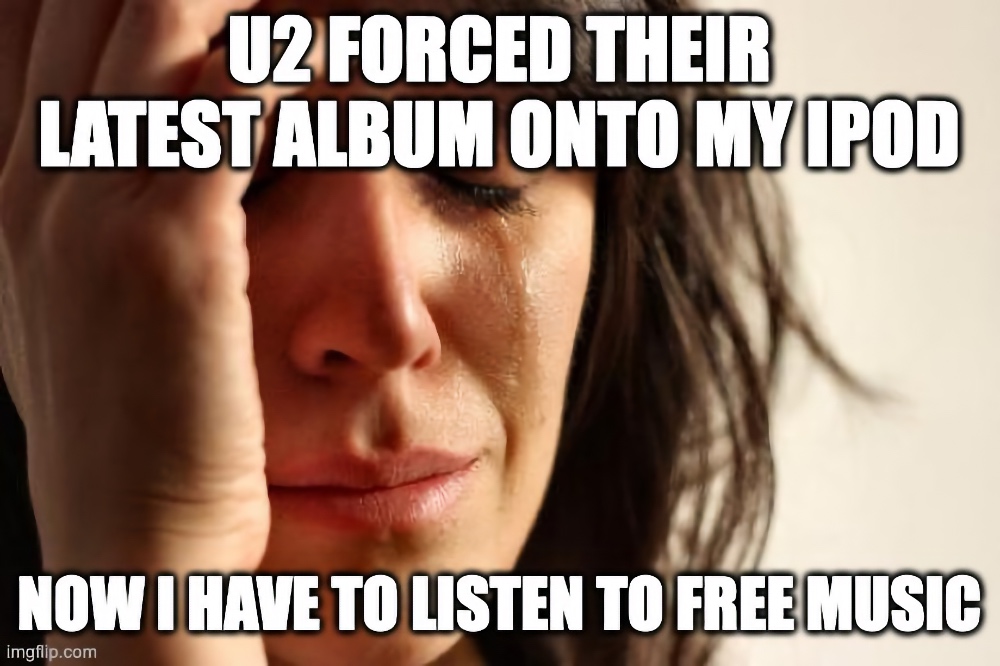
Some, this writer included, saw it as just another “first world problem” and decided to stir the pot a bit.
I even shared a meme to try and calm everyone.
While the free album wasn’t received in quite the way Apple and U2 had expected, the publicity did spur new sales of U2’s older albums, with 17 of their previous albums currently ranking on the iTunes Top 100, with a remastered version of “The Joshua Tree,” the band’s 1987 release, at the No. 12 spot.