

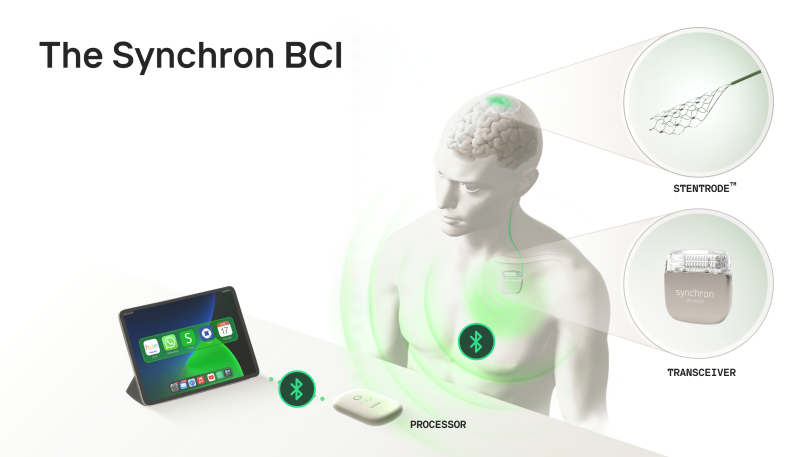
For the first time, a video shows a person controlling an iPad solely with his mind. The accomplishment is possible, thanks to Apple’s new brain-computer interface (BCI) protocol and Synchron‘s implantable Stentrode device working in tandem.
A new video from Synchron shows how Mark, a person living with ALS and a participant in the company’s COMMAND clinical study, can navigate the iPad’s Home Screen, launch apps, and compose text, all solely with his mind, without his hands, or speaking, or using his eyes.
Mark’s use of the iPad is enabled by Apple’s built-in accessibility feature, Switch Control, and Synchron’s Stentrode™ device, which detects motor intention from blood vessels within the brain. These signals are wirelessly transmitted to an external decoder, which interfaces directly with iPadOS through the new HID protocol. The system allows for closed-loop communication, where an iPad, iPhone or Apple Vision Pro shares contextual screen data with the BCI decoder to optimize real-time performance, enabling precise, intuitive control using just neural signals.
“When I lost the use of my hands, I thought I had lost my independence,” said Mark. “Now, with my iPad, I can message my loved ones, read the news, and stay connected with the world, just by thinking. It’s given me part of my life back.”
“This is the first time the world has seen native, thought-driven control of an Apple device in action,” said Dr. Tom Oxley, Synchron’s founder and CEO. “Mark’s experience is a technical breakthrough, and a glimpse into the future of human-computer interaction, where cognitive input becomes a mainstream mode of control.”
Apple and Synchron first collaborated on early pilot projects in 2024, using the Apple Vision Pro, which Mark was able to control with thought. The integration then was then expanded to iPhones and iPads, thanks to support built into Apple’s accessibility frameworks. Apple is planning to roll out broader support for the BCI HID protocol across its device platforms later in 2025.
Synchron is continuing controlled rollouts of the BCI HID experience with clinical participants, with broader availability to come.
